Iemand zegt iets aan de andere kant van de kamer, en het woord zweeft nog even rond voordat het landt. Stemmen klinken hol, de tv staat net iets te hard. Dat is galm, en het is goed op te lossen.
Galm verminderen thuis hoeft niet te betekenen dat je grijze schuimplaten op je mooie muur aanbrengt. Hieronder lees je waar galm vandaan komt, hoeveel je er echt aan moet doen, en hoe je rust toevoegt met wandkunst.
In a nutshell
- Galm ontstaat doordat geluid kaatst op harde, gladde oppervlakken; moderne interieurs galmen daarom vaak.
- Begin met wat je al hebt: vloerkleed, gordijnen, zacht meubilair en textiel halen de scherpste randjes eraf.
- Nagalm in de woonkamer zit tussen twee harde vlakken die tegenover elkaar liggen; pak de grootste eerst aan.
- Bekleed circa 15 tot 30% van het vloeroppervlak; een aaneengesloten wand werkt veel beter dan losse accenten.
- Maeven Art maakt akoestische wandkunst van 9 mm PET-vilt, NRC tot 0,6, met warm beige als tijdloze hardloper.
Waarom galmt het juist in mooie, moderne huizen?
De huizen waar we het meest van houden galmen vaak het meest. Strakke wanden, gladde vloeren, grote ramen en hoge plafonds zijn de ingrediënten van een rustig, modern interieur, en tegelijk van geluid dat blijft kaatsen.
Geluid heeft zachtheid nodig om in te zakken: een hard oppervlak gooit het terug, een zacht en poreus oppervlak vangt het op. De truc is dus niet meer spullen, maar de juiste zachtheid op de juiste plek. Wil je dieper begrijpen wat er gebeurt, lees dan wat nagalmtijd is en hoe je die optimaliseert.
De makkelijke eerste stappen
Kijk eerst wat je al hebt; vaak haal je de scherpste randjes er met kleine ingrepen al af.
- Een groot vloerkleed in de ruimte met de meeste galm; vloeren zijn vaak de grootste boosdoener.
- Gordijnen van zwaardere stof, het liefst in plooi, langs een kale glaswand.
- Een gevulde boekenkast, planten en textiel: alles wat onregelmatig en zacht is helpt mee.
- Zacht meubilair, een bank met kussens in plaats van strak leer.
Deze stappen verzachten de galm, maar lossen hem zelden helemaal op. Zie ook wat akoestiek is en hoe je die verbetert en of akoestische panelen tegen geluidsoverlast helpen.
Nagalm in de woonkamer verminderen: begin bij de grootste vlakken
Voor de meeste mensen begint galm in de woonkamer: een gesprek aan tafel dat hol wordt, de televisie die 's avonds te scherp klinkt. De reden is bijna altijd dezelfde. De woonkamer heeft de grootste, hardste vlakken van het huis: een gladde vloer, een kale wand boven de bank en vaak een glaspui naar de tuin. Nagalm ontstaat waar twee van die vlakken recht tegenover elkaar liggen.
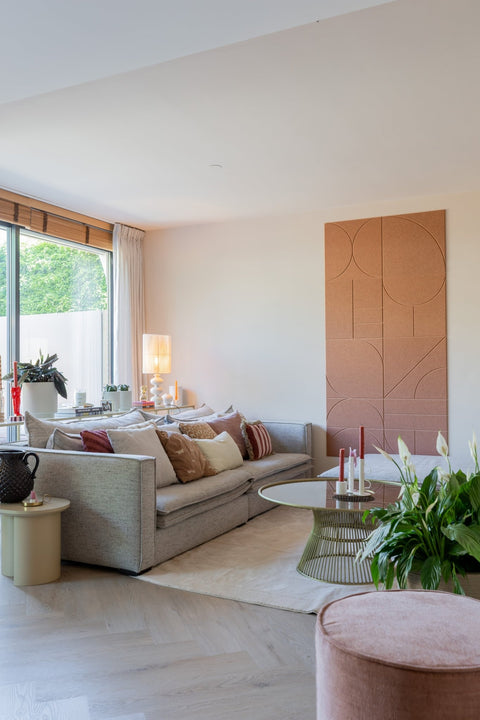
Begin daarom bij het grootste harde oppervlak. Een ruim vloerkleed neemt de eerste scherpte weg en zwaardere gordijnen langs de glaswand doen de rest. Voor merkbaar minder galm heb je daarnaast een aaneengesloten zacht wandvlak nodig, het liefst tegenover je grootste raam of tegenover de bank. Eén volle wand doet hoorbaar meer dan losse panelen door de kamer verspreid.
Hoeveel absorberend oppervlak heb je echt nodig?
Dit is de vraag die de meeste mensen overslaan, en precies daarom blijft het bij sommigen toch galmen. Een goede vuistregel: bekleed ongeveer 15 tot 30% van het vloeroppervlak met absorberend oppervlak. Bij veel galm of een hoge ruimte zit je aan de bovenkant van die marge. Onze akoestische wandkunst is van 9 mm PET-vilt en absorbeert tot 0,6 NRC, gemeten in een volledige ruimte. Lees ook hoe PET-vilt geluid absorbeert, of geef je wand op in de wandenstudio en zie meteen hoeveel je nodig hebt.
Stilte die je ook wílt zien
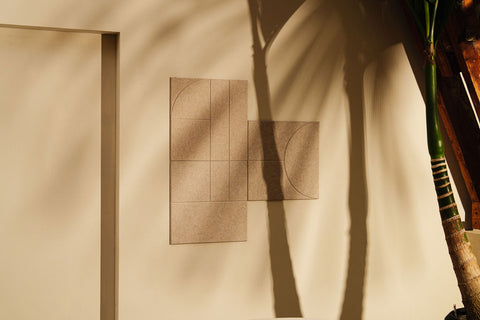
Akoestiek werd lang behandeld als een noodzakelijk kwaad: grijze platen die je liefst verstopt. Wij maken er akoestische wandkunst van, handgemaakt in ons atelier in Nederland, in tinten van warm zand tot diepgroen. Warm beige is de tijdloze hardloper. Lees hoe dat werkt als functionele kunst aan de wand.
De panelen hebben een zelfklevende achterkant, dus een wand hangt in 15 minuten zonder de muur te beschadigen. Wil je liever één statement boven de bank, dan zijn er akoestische schilderijen van 18 mm, twee lagen vilt, met een voorgemonteerd Z-profiel. Begin waar de galm je het meest stoort: de woonkamer, het thuiskantoor of een kale gang. De keuzehulp wijst je de richting.
Frequently Asked Questions
Hoe kan ik galm verminderen?
Begin met wat je al hebt: een groot vloerkleed, zwaardere gordijnen, planten en zacht meubilair halen de scherpste randjes eraf. Voor echt rustige akoestiek voeg je absorberend wandoppervlak toe. Een goede vuistregel is om ongeveer 15 tot 30% van het vloeroppervlak met absorberend oppervlak te bekleden, bijvoorbeeld met akoestische viltpanelen.
Hoe laat ik mijn woonkamer minder hol klinken?
Voeg zachte, poreuze oppervlakken toe: textiel, een vloerkleed en een aaneengesloten wand met akoestische panelen. Een volle wand met akoestische wandkunst werkt veel beter dan losse accenten, en brengt meteen warmte en kleur in de ruimte.
Kunnen planten de galm verminderen?
Een beetje, maar minder dan vaak gedacht. Losse planten breken vooral de weerkaatsing met hun onregelmatige vorm; pas een dichte plantenwand neemt merkbaar geluid op. Voor hoorbaar minder nagalm heb je een aaneengesloten vlak absorberend materiaal nodig. Planten zijn dus aanvulling, geen oplossing.
Hoe kan ik galm in mijn keuken verminderen?
Een keuken is akoestisch lastig: harde kastdeuren, een tegelwand, een gladde vloer en weinig textiel. Begin met een loper in de looproute en zachte zitting op de eetstoelen. Voor merkbaar effect voeg je absorberend wandoppervlak toe boven de eethoek, weg van spatzones en warmte, zodat het vilt droog blijft.
Helpt een vloerkleed echt tegen galm?
Ja, een groot vloerkleed verzacht galm merkbaar omdat de vloer vaak het grootste harde oppervlak in huis is. Het lost het zelden helemaal op; in een hoge of grote ruimte combineer je het kleed het best met absorberend wandoppervlak.
Hoe kan ik geluid in huis verminderen?
Dat hangt af van het soort geluid. Voor galm binnen je eigen ruimte voeg je zachte, poreuze oppervlakken toe: textiel, een vloerkleed en een wand met akoestische panelen. Voor geluid van buiten of van de buren gaat het om geluidsisolatie, een ander vraagstuk. Onze panelen absorberen tot 0,6 NRC, gemeten in een volledige ruimte.
Hoeveel akoestische panelen heb ik nodig?
Reken op ongeveer 15 tot 30% van het vloeroppervlak met absorberend oppervlak voor hoorbaar minder galm. Bij veel galm of een grote ruimte zit je aan de bovenkant van die marge. De wandenstudio berekent op basis van je wand precies hoeveel panelen je nodig hebt.
Is PET-vilt brandveilig en duurzaam?
Onze panelen zijn van PET-vilt, brandvertragend met brandklasse B-s1,d0, en bestaan voor 40 tot 60% uit gerecycled PET. Ze worden circulair geproduceerd in Nederland. Meer hierover op onze pagina over duurzaamheid en circulaire productie.
Moet ik boren om de panelen op te hangen?
Nee. De panelen hebben een zelfklevende achterkant, dus je brengt ze strak aan zonder de muur te beschadigen. Akoestische schilderijen hebben een voorgemonteerd Z-profiel. Zie onze montagegids.