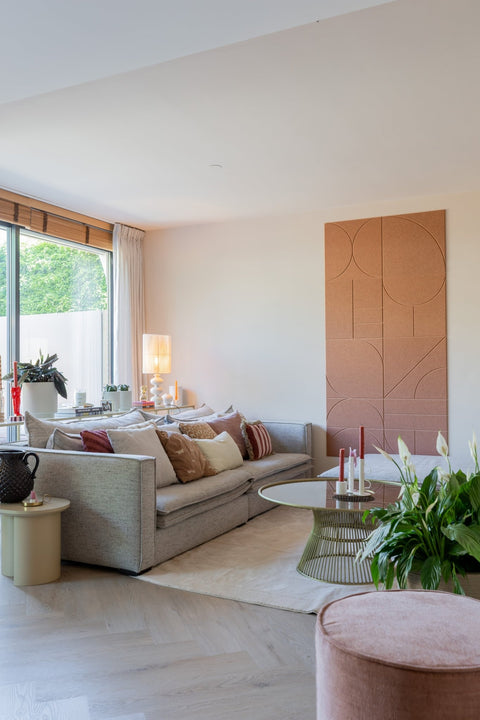
Je belt iemand vanuit je eigen woonkamer en je hoort jezelf terug. Stemmen kaatsen, de tv staat te hard, en aan het eind van de dag voelt het huis vermoeiender dan het zou moeten. Dan komt de vraag: helpen akoestische panelen tegen geluidsoverlast? Het eerlijke antwoord is ja, maar niet zoals je waarschijnlijk denkt.
Kort gezegd: akoestisch vilt is geluiddempend, niet geluidsisolerend.
In a nutshell
- Ja, panelen helpen tegen galm en nagalm bínnen je ruimte, niet tegen geluid van buiten.
- Buren, contactgeluid en straatlawaai vragen om isolatie, niet om absorptie.
- Voldoende aaneengesloten oppervlak op de juiste wand maakt het verschil, geen losse accenten.
- Vuistregel: bekleed ongeveer 15 tot 30% van je vloeroppervlak met absorberend oppervlak.
- 9 mm PET-vilt, handgemaakt in ons atelier, 40 tot 60% gerecycled, met zelfklevende achterkant.
Akoestische panelen tegen geluidsoverlast: het korte antwoord
Akoestische panelen pakken het geluid aan dat éénmaal in een ruimte is: de galm, het kaatsen van stemmen tegen harde muren en vloeren. Wat ze niet doen, is geluid van buiten tegenhouden. Een paneel is geen muur; het maakt een harde ruimte weer zacht, en ondertussen je wand mooier. Wil je eerst de basis snappen, lees dan wat akoestische wandpanelen van vilt zijn en hoe ze werken.
Wat ze wél oplossen: galm en nagalm
De meeste geluidsoverlast in huis is eigenlijk slechte akoestiek binnen de ruimte zelf: strakke interieurs met beton, glas en weinig textiel laten geluid eindeloos terugkaatsen.
- Stemmen en tv die scherp klinken in een lege woonkamer
- Galm tijdens videocalls, waarbij jij jezelf terughoort en de ander echo hoort
- Drukte die zich opstapelt: kinderen, keukengeluiden, muziek door elkaar
Akoestisch PET-vilt absorbeert die hoge en midden tonen, zodat de ruimte zachter klinkt. Lees hoe PET-vilt geluid absorbeert.
Wat ze niet oplossen: geluid van de buren en contactgeluid
Hier zijn we graag eerlijk. Akoestische panelen zorgen voor geluidsabsorptie, niet voor geluidsisolatie.
- De buren die je door de muur hoort: dat vraagt om zwaardere isolatie in de constructie.
- Contactgeluid zoals voetstappen van bovenburen of een bonkende wasmachine reist door de bouwconstructie, niet door de lucht.
- Verkeer of straatlawaai via ramen is een isolatie- en raamvraagstuk.
Twijfel je in welke categorie jouw probleem valt? Lees wat akoestiek is of hoe je galm thuis vermindert.
Hoeveel panelen heb je nodig?
Eén paneel boven de bank verandert de akoestiek nauwelijks. Vuistregel: bekleed ongeveer 15 tot 30% van je vloeroppervlak; bij een woonkamer van 30 m² is dat 5 tot 9 m² aan panelen. Begin met een aaneengesloten vlak op de wand die het hardst terugkaatst, vaak de kale muur tegenover je zithoek, en reken in vierkante meters in plaats van losse stuks.
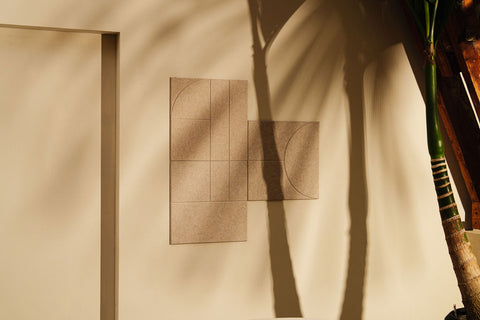
Onze panelen zijn 9 mm PET-vilt, handgemaakt in ons atelier in Nederland, 40 tot 60% gerecycled, met een absorptie tot 0,6 NRC gemeten in een volledige ruimte. De zelfklevende achterkant maakt dat een wand in 15 minuten hangt. In de wandenstudio zie je wat jouw ruimte nodig heeft.
Houden akoestische panelen het geluid binnen?
Soms is de vraag andersom: je maakt zelf geluid en wilt dat het de kamer niet uit gaat. Panelen absorberen het geluid dat in een ruimte rondgaat, maar houden het niet binnen. Wil je een kamer echt geluiddicht, dan is dat isolatie in wanden, vloer en deur.
Wat ze wél doen, hoor je meteen: in een muziekkamer of thuisbioscoop nemen ze de scherpe weerkaatsing weg, zodat wat je speelt voller klinkt in plaats van rommelig. En dat zonder dat de ruimte eruitziet als een studio. Onze akoestische schilderijen van 18 mm, twee lagen vilt, blijven aan de muur gewoon een schilderij; op een thuiswerkplek werkt een rustig grid, zie akoestiek op kantoor verbeteren en het overzicht van akoestische viltpanelen.
Frequently Asked Questions
Helpen akoestische panelen tegen geluid van de buren?
Nee. Panelen absorberen galm bínnen jouw ruimte, maar houden geluid van de buren of van buiten niet tegen. Dat vraagt om geluidsisolatie in de muur of constructie. Voor het kaatsen en de onrust in je eigen kamer zijn ze juist ideaal.
Hoe muren isoleren tegen geluid buren?
Daarvoor heb je massa en ontkoppeling nodig, geen absorptie: een voorzetwand op eigen regelwerk, gevuld met minerale wol en afgewerkt met gipsplaat, losgekoppeld van de bestaande muur. Akoestische panelen doen dat werk niet; die verbeteren de klank van de ruimte waarin je zit. Laat een isolatievraagstuk bij twijfel beoordelen door een bouwkundige.
Helpen ze tegen contactgeluid, zoals voetstappen van bovenburen?
Nee. Contactgeluid reist door de bouwconstructie, niet door de lucht. Akoestische panelen werken op luchtgeluid (stemmen, tv, galm) en hebben geen effect op bonkende voetstappen of een wasmachine boven je.
How much noise do acoustic panels reduce?
Akoestische panelen houden geluid niet tegen, ze absorberen het. Ze nemen de galm en nagalm weg die in je ruimte ontstaat, zodat een kamer hoorbaar zachter klinkt. Hoeveel verschil je hoort hangt af van het oppervlak dat je bekleedt: reken op circa 15 tot 30% van je vloeroppervlak voor een duidelijk hoorbaar effect, bij een absorptie tot 0,6 NRC gemeten in een volledige ruimte.
Wat dempt geluid in de woonkamer?
Alles wat zacht en poreus is: een groot vloerkleed, zwaardere gordijnen, een gevulde boekenkast en textiel. Die halen de scherpste randjes eraf. Voor merkbaar minder galm voeg je daarnaast een aaneengesloten wandvlak van absorberend materiaal toe, op de wand die het hardst terugkaatst.
What are the disadvantages of acoustic panels?
Het belangrijkste om te weten: ze lossen alleen galm bínnen je ruimte op, niet geluid van buiten of contactgeluid. Verder werken losse accenten nauwelijks; je hebt voldoende aaneengesloten oppervlak nodig. Daar staat tegenover dat onze panelen akoestische wandkunst zijn die je ruimte ook mooier maken, met een zelfklevende achterkant die je moeiteloos aanbrengt.
Welke panelen dempen geluid het beste?
Panelen van zacht, mat akoestisch PET-vilt met een hoge dichtheid absorberen geluid het effectiefst, omdat ze de hoge en midden tonen opvangen die een ruimte hard laten klinken. Onze panelen zijn 9 mm dik met een dichtheid van circa 2000 g/m². Wat het verschil maakt voor het geluid is niet de kleur maar het aaneengesloten oppervlak dat je op de juiste wand bekleedt.
Waarvan zijn de panelen gemaakt?
Van 9 mm akoestisch PET-vilt, handgemaakt in ons atelier in Nederland, met 40 tot 60% gerecycled materiaal en brandklasse B-s1,d0. Je brengt ze met de zelfklevende achterkant aan, zonder boren.