You scroll through dozens of wall panels. One supplier swears by warm wood with fine slats, while another swears by soft felt in earth tones. Both promise a sense of calm. But which one actually gives you that sense of calm?
When choosing between felt wall panels and wood panels, it’s not about which looks best in a photo, but about how a wall sounds, feels, and performs in your space. Below, we compare the two, including why we chose felt. If you’d like to know what acoustic felt panels are first, start there.
In a nutshell
- Felt absorbs sound throughout the entire thickness of the material; wood relies on the acoustic layer behind it.
- Wood provides natural warmth and a rhythmic pattern of slats: a plus for those who prioritize ambiance.
- Maeven Art-felt: 9 mm, self-adhesive backing, 40–60% recycled PET, handmade in our studio (fire rating B-s1,d0).
- Choose felt for a calm, soft, and subdued atmosphere; warm beige is the most popular, timeless shade.
- Rule of thumb: Cover about 15 to 30% of your floor area with an absorbent surface to significantly reduce audible noise reverberation.
Wood or felt panels: Which one really absorbs sound?
This is the difference you hear before you see it.
- Felt is porous and soft. Sound waves penetrate the fibers and lose their energy there. reverberation audibly decreases, which is pleasant in open spaces, rooms with high ceilings, and minimalist interiors. Our acoustic wall art made of PET felt achieves a sound absorption coefficient of up to 0.6 NRC, measured in an entire room.
- Wood absorbs sound mainly because of what's behind it: the open spaces between the slats and an absorbent nonwoven fabric or felt on the back panel. The wood itself reflects sound.
The term “wooden panels” covers a wide range of items: decorative wall panels, the thin slats of a slatted wall, and the sleek designer walls you see in offices. sound absorbing They all rely on the layer behind them. If you want sound absorption with minimal thickness, felt is the most direct solution. You can read more about how PET felt absorbs sound here.
Ambience and style: warm wood or soft felt
Neither one wins here. It depends on the feeling you're looking for.
Wood adds a classic, natural warmth. Vertical slats make a room appear taller and fit well in a Scandinavian or sleek, modern interior.
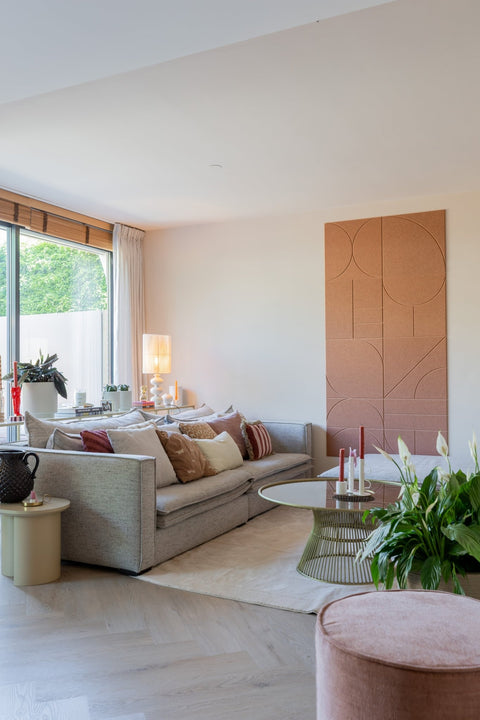
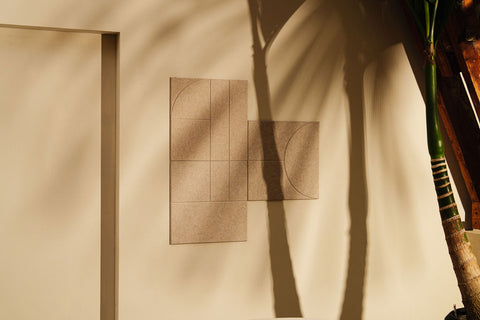
Felt feels softer and quieter—both literally and figuratively. It doesn’t reflect light, so the wall remains calm and matte. In earth tones such as warm beige, sand, or deep green, our acoustic wall art creates a subtle backdrop against which furniture and art come to life. Warm beige is our most popular shade. A “ Sadé ” or “ Loa ” panel hangs like a sculpture, not like an acoustic fixture. If you’re unsure about the style, read about which interior styles pair well with acoustic art.
Installation, Maintenance, and Durability
Application
Our panels have a self-adhesive backing: you can apply each panel smoothly to a clean, flat wall without drilling and without damaging the wall. A wall can be installed in 15 minutes. View the installation instructions. Wooden slat walls are usually screwed in place or mounted on a frame.
Maintenance
Clean felt with a soft brush or a vacuum cleaner set to low power. Wood should be wiped down with a cloth from time to time and, occasionally, treated with a nourishing oil or varnish.
Sustainability
Our panels are 9 mm thick, made of PET felt containing 40–60% recycled material, handmade in our workshop in the Netherlands, and have a fire rating of Class B-s1,d0. Learn more about our circular production process. Wood is a renewable resource, provided you choose FSC-certified wood. If you’d like to explore your material options further, read all about acoustic felt.
Which one fits your space, and how many do you need?
A simple guideline:
- Choose felt if tranquility is your top priority: a bedroom, home office, reading nook, or a living space with plenty of reverberation. It’s also a great choice if you want to avoid drilling or are looking for a soft, subdued atmosphere.
- Choose wood if you want that warm, woody feel and the rhythm of the slats, and consider the acoustics a bonus.
How much wall space do you need to cover to hear the difference? Allow for 15 to 30% of your floor area to be covered with sound-absorbing material. A 25 m² living space would require roughly 4 to 7.5 m². Start with the largest bare surfaces; that’s where felt is most effective at reducing reverberation. Calculate it in the wall studio, or read more about reducingreverberation at home. If you’re unsure about the color, request a sample kit and view the earth tones in your own lighting.
Why We Chose Felt
Felt makes a room quieter, and we found that silence alone to be boring. That’s why we turned it into wall art: simple at its core, and completely customizable to suit your own style.
PET felt is not wool felt. It is a fiber spun from recycled PET and compressed into a dense, sturdy mat. That density is exactly what a wall needs: sound penetrates the fibers and loses its intensity there, rather than bouncing back into the room.
If you’re looking for sound absorption and a work of art all in one, felt does both. Our Acoustic wall art hang on the wall like a sculpture and soften the reverberation, without slats, a frame, or visible hardware. Be sure to check out the acoustic felt panels as well.
Frequently Asked Questions
Do felt panels provide better sound insulation than wooden panels?
Felt absorbs sound throughout the entire thickness of the material and achieves a sound absorption coefficient (NRC) of up to 0.6, as measured in an entire room. Wooden slat walls primarily dampen sound thanks to their open spaces and the acoustic layer behind them. If you want quiet with minimal thickness, felt is the more direct solution.
Which material is best at absorbing sound?
Soft, porous materials that absorb sound rather than reflect it: textiles, carpet, and acoustic felt. Hard materials such as wood, glass, or stucco, on the other hand, reflect sound. A wooden panel, therefore, only absorbs sound if there is an absorbent layer behind it.
Which type of wall panel is best?
That depends on what you're looking for. If you're mainly looking to reduce reverberation and want a soft, matte wall, then a felt panel is the logical choice. If you're looking for the warmth of natural wood and a vertical rhythm, then a slatted wall is a better fit. You should also consider the thickness, the fire rating, and how the panel is mounted on the wall.
What are the Maeven Art felt wall panels made of?
Made from PET felt containing 40–60% recycled material, handmade in our workshop in the Netherlands. The panels have a fire rating of B-s1,d0 and are 9 mm thick.
How do I install felt wall panels?
Our panels have a self-adhesive backing and can be applied directly to a clean, flat wall—no drilling, no mounting profiles, and no damage to the wall. A panel can be hung in 15 minutes. Acoustic paintings can be hung straight on the wall using the pre-assembled Z-profile.
What should you look for when choosing wall panels?
Pay attention to the material and how it behaves. Felt absorbs sound deeply and creates a soft, subdued atmosphere, while wood reflects sound and relies on the layer behind it. Also consider the installation method, the thickness, the fire rating, and whether the color matches your interior.
Does wood also have advantages over felt?
Absolutely. Wood provides a natural warmth and a distinctive slatted pattern that enhances the visual appeal, and it’s a renewable resource. Be sure to choose FSC-certified wood. For those who prioritize ambiance and view acoustics as a bonus, wood is a good choice.