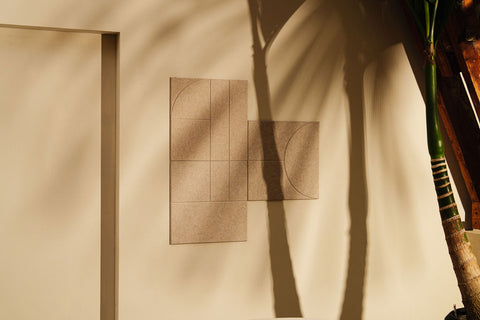
Acoustic felt: Everything you need to know about this sound-absorbing solution
Acoustic felt is a popular solution for anyone dealing with reverberation, echoes, or poor acoustics in their home, office, or public spaces. But what exactly is acoustic felt, and why is it used so often in modern interiors? In this blog post, we answer five frequently asked questions about this versatile material.
1. What exactly is acoustic felt, and how does it work?
Acoustic felt is a special type of felt, typically made from PET fibers (40–60% recycled PET bottles), that is designed to absorb sound. Unlike decorative or craft felt, this material is engineered with a specific density, thickness, and fiber structure that ensures optimal sound absorption, including fire resistance.
When sound waves strike a surface, they are partly reflected and partly absorbed. Acoustic felt breaks up these sound waves, significantly reducing reverberation and echoes. The thicker and denser the material, the better the absorption value (NRC value, Noise Reduction Coefficient). PET felt that is 9 mm thick or thicker generally performs very well in this regard.
2. What is the difference between regular felt and acoustic felt?
Standard felt is often thin (1 to 3 mm) and is mainly used for craft projects, decoration, or as a soft underlay. It has little to no acoustic effect, as it simply lacks the mass or fiber density needed to effectively absorb sound vibrations.
Acoustic felt, on the other hand, is specifically designed to absorb and disperse sound waves. It is typically 9 to 25 mm thick, thermally compressed for high density, and contains airy microstructures that “capture” and neutralize sound. In addition, it is fire-resistant, dimensionally stable, and produced sustainably.
3. How much noise does acoustic felt actually absorb in practice?
The degree of sound absorption depends on the amount of felt used, how it is installed, and the room itself. A single 50x50 cm panel will slightly improve the acoustics, but a wall entirely covered with acoustic felt can make the difference between a hollow, echoing room and a quiet, serene environment.
The sound absorption coefficient is often expressed as NRC (Noise Reduction Coefficient). A good acoustic solution scores between 0.30 and 0.80, meaning it absorbs 70% to 95% of incident sound. Maeven Art’s PET felt scores highly thanks to the combination of material, thickness (9 mm or more), and strategic placement on reflective walls.
Example: In a living room with many hard surfaces (concrete, glass, wood), just four to six panels can make a noticeable difference in speech intelligibility and the perception of quiet.
4. Where is the best place to use acoustic felt in your home or office?
Acoustic felt is both versatile and stylish. Thanks to the design appeal of Maeven Art’s panels and artwork, functionality is combined with aesthetics.
Popular uses:
• Living room: as wall decor above the sofa or dining table.
• Bedroom: above the bed for peace and warmth.
• Home office: Sit at your desk to reduce echo during video calls.
• Office: in meeting rooms, reception areas, or flexible workspaces.
• Hospitality Industry: to reduce noise and reverberation in restaurants or cafes.
• Studios or podcasts: as a sound-absorbing backdrop.
Maeven Art also offers a modular approach: combine multiple panels or paintings to create a unique work of art that also serves an acoustic purpose.
5. Is acoustic felt easy to install yourself?
Yes, that’s one of the biggest advantages of Maeven Art acoustic felt. All the panels are self-adhesive: all you have to do is peel off the protective layer and press the panel against the wall. No drilling, no screws, no hassle.
Our Acoustic wall art come with convenient hanging systems. This makes the system completely plug-and-play, so anyone can install it in just a few minutes. Plus, the panels are lightweight, which makes installation even easier.
Tip: For best results, place the panels at "primary reflection points," such as opposite windows or near bare walls.
Bonus: The Relationship Between Sound and Acoustics
Acoustics is all about how sound behaves in a space. Sound itself is a vibration of air molecules that travel in waves. Hard materials reflect these vibrations, causing reverberation and echoes. Soft or porous materials, such as acoustic felt, absorb the vibrations and make a space acoustically quieter.
In short: good acoustics aren’t created by silence, but by control. And with acoustic felt from Maeven Art, you can achieve the right balance in your home.
Would you like to see for yourself what acoustic felt can do for your space?
Order a sample kit or browse our latest collection online. Need professional advice? Feel free to contact our team.