Je loopt voor het eerst je nieuwe, lege kamer binnen. De muren zijn kaal, de vloer ligt er glad bij. Je zegt iets en je eigen stem komt een fractie later terug, hol en breed. Het klinkt als een gymzaal. Precies dat nahangen van geluid noemen we nagalm.
Je hoeft geen akoestisch ingenieur te zijn om nagalmtijd te begrijpen, laat staan om het op te lossen. Hieronder: wat nagalmtijd is, welke waarden prettig zijn, en hoe je die verkort met akoestische wandkunst.
In a nutshell
- Nagalm is het nahangen van geluid nadat de bron stopt; de duur daarvan heet nagalmtijd, gemeten als RT60.
- Een lange nagalmtijd vermoeit: gesprekken kosten moeite en videocalls klinken hol.
- Richtwaarden: ongeveer 0,4 tot 0,6 s voor woon- en slaapkamer, korter voor werkplekken.
- Verkorten doe je door harde oppervlakken af te wisselen met zacht materiaal: reken op 15 tot 30% van het vloeroppervlak.
- Akoestische wandkunst van 9 mm PET-vilt verkort de nagalmtijd, met een geluidsabsorptie tot 0,6 NRC in een volledige ruimte gemeten.
Wat is nagalm en wat is nagalmtijd?
Klap in je handen in een lege kamer. De klap zelf is kort, maar je hoort hem nog even uitsterven. Dat uitsterven is nagalm. De tijd die het kost voordat het geluid praktisch is weggestorven, is de nagalmtijd.
In de akoestiek wordt dit uitgedrukt als RT60: de tijd in seconden waarin het geluidsniveau met 60 decibel daalt nadat de geluidsbron stopt. Hoe langer die tijd, hoe galmender en onrustiger een ruimte klinkt. Hoe korter, hoe helderder en kalmer.
Dat getal hoef je niet te onthouden. Wat telt is het gevoel erachter: een korte nagalmtijd laat geluid zacht landen, een lange laat het rondtollen. Lees ook wat akoestiek is en hoe je het verbetert.
Waarom een lange nagalmtijd vermoeit
In een ruimte met een lange nagalmtijd buitelen geluiden over elkaar heen en moet je brein harder werken om spraak eruit te filteren. Een paar herkenbare signalen:
- Je vraagt vaker "wat zeg je?": gesprekken kosten merkbaar moeite.
- De tv of muziek moet harder dan eigenlijk nodig is.
- Je voelt je moe na een dag thuiswerken, zonder duidelijke reden.
- Videocalls klinken hol en je stem komt galmend over bij de ander.
Herken je er twee of meer, dan is de nagalmtijd waarschijnlijk de stille boosdoener. Waarom rust in huis zo veel doet, lees je in waarom akoestische panelen essentieel zijn voor een rustgevende ruimte.
Welke nagalmtijd is prettig? Richtwaarden per ruimte
De ideale nagalmtijd hangt af van waar je de ruimte voor gebruikt. Als globaal kompas:
- Woonkamer en slaapkamer: ongeveer 0,4 tot 0,6 seconden voelt huiselijk en rustig.
- Thuiswerkplek en kantoor: rond de 0,4 seconde houdt spraak helder op calls.
- Open keuken, hal en trapgat: vaak de galmrijkste plekken, waar elke verkorting direct merkbaar is.
Lege ruimtes met gladde wanden, glas en harde vloeren tikken makkelijk over de 1 seconde, dat is het gymzaal-gevoel uit de intro. Het doel is niet een muisstille ruimte, maar een aangename waarde: een beetje leven mag blijven, alleen het eindeloze nahangen verdwijnt. Galmt het vooral boven je hoofd, kijk dan ook naar plafond en akoestiek.
Nagalmtijd meten of berekenen
Soms wil je een getal, bijvoorbeeld om te vergelijken vóór en nadat je iets aan de wand hebt gehangen. Voor thuis is een meet-app op je telefoon het handigst: je staat midden in de kamer, klapt één keer stevig in je handen, en de app leest af hoe snel dat geluid wegvalt. Wat je terugkrijgt is de RT60 in seconden. Meet op een paar plekken, neem het gemiddelde, en herhaal de meting nadat je een vloerkleed hebt neergelegd of een wand hebt bekleed. Dat vergelijken zegt meer dan één losse waarde. Wil je het precies weten, dan komt professionele meetapparatuur in beeld.
Reken je liever, dan is de kern eenvoudig: de nagalmtijd hangt af van hoe groot de ruimte is en hoeveel zacht materiaal erin zit. Een woonkamer van 30 m² met een plafond op 2,6 meter is ongeveer 78 kubieke meter. Zitten daar vooral harde vlakken in, dan tikt de nagalmtijd over de seconde. Voeg je zachte vierkante meters toe, dan zakt die tijd vanzelf.
Zo verkort je de nagalmtijd
Het principe is simpel: je wisselt harde, gladde oppervlakken af met zachte oppervlakken die geluid opvangen in plaats van terugkaatsen. Tapijt, gordijnen en stoffen meubels helpen mee, maar de grootste kale vlakken zijn meestal je wanden. Juist daar valt de meeste winst te halen, het liefst met iets wat je ook graag ziet hangen.
Als vuistregel bekleed je ongeveer 15 tot 30% van het vloeroppervlak met absorberend oppervlak. Voor een woonkamer van 30 m² is dat zo'n 4,5 tot 9 m². Begin bij de grootste, kaalste wand, vaak tegenover een raam of een harde vloer. Je hoeft niet alles in één keer te doen.
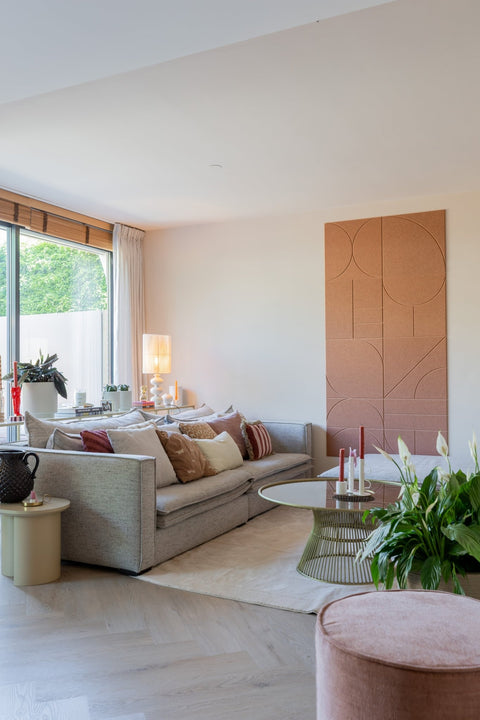
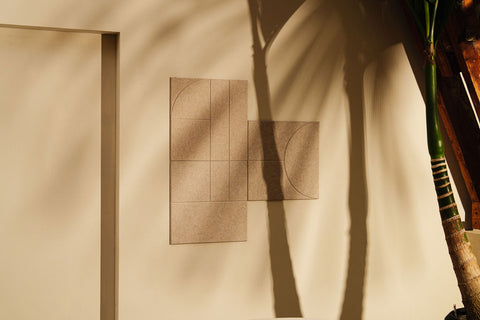
Onze akoestische wandkunst van PET-vilt (akoestische viltpanelen van 9 mm) is een zacht, mat materiaal dat geluidsenergie omzet en zo de nagalmtijd verkort. In een volledige ruimte gemeten halen ze een geluidsabsorptie tot ongeveer NRC 0,6. De panelen worden handgemaakt in ons atelier in Nederland van PET-vilt met 40 tot 60% gerecycled materiaal, met brandklasse B-s1,d0, en hebben een zelfklevende achterkant: een wand hangt in 15 minuten, zonder boren. Akoestische schilderijen zijn 18 mm dik, met een dubbele laag voor extra demping en een voorgemonteerd Z-profiel. Meer over het materiaal lees je in hoe PET-vilt akoestische wandpanelen geluid absorberen.
Stel je wand samen in de wandenstudio, bekijk de akoestische viltpanelen of laat je inspireren door de akoestische schilderijen.
Frequently Asked Questions
Hoe kan de nagalm worden verminderd?
Voeg zacht, geluidsabsorberend oppervlak toe op de plek waar geluid het hardst terugkaatst. De grootste kale vlakken zijn meestal je wanden. Reken op 15 tot 30% van het vloeroppervlak, waarbij vloerkleed en gordijnen meetellen.
Welke methoden zijn er om nagalm te beheersen?
Drie routes: zacht textiel toevoegen (vloerkleed, gordijnen), absorberend materiaal op de wanden, en bij hoge ruimtes ook op het plafond. De wanden leveren meestal het meeste op.
Wat betekent RT60 precies?
RT60 is de tijd in seconden waarin het geluidsniveau in een ruimte met 60 decibel daalt nadat de geluidsbron stopt. Het is de standaardmaat voor nagalmtijd: hoe hoger de RT60, hoe galmender de ruimte klinkt.
Wat is een goede nagalmtijd voor een woonkamer?
Ongeveer 0,4 tot 0,6 seconden voelt huiselijk en rustig. Lege ruimtes met harde vloeren en veel glas zitten al snel boven de 1 seconde, dan klinkt het hol.
Wat is de normale nagalmtijd in huis?
In een normaal ingerichte woning ligt de nagalmtijd vaak tussen ongeveer 0,4 en 0,8 seconden. Veel zachte materialen houden hem aan de lage, prettige kant. Strakke, minimalistische ruimtes lopen makkelijk op tot boven de 1 seconde. Lees ook hoe je galm thuis vermindert.
Hoe bereken je de nagalmtijd?
De nagalmtijd hangt af van hoe groot de ruimte is en hoeveel zacht materiaal erin zit dat geluid opvangt. Een ruime kamer met veel harde vlakken galmt lang na, dezelfde kamer met tapijt, gordijnen en een zachte wand galmt merkbaar korter. In de praktijk hoef je niet te rekenen: voeg absorberend oppervlak toe en de nagalmtijd zakt vanzelf.
Hoe verkort ik de nagalmtijd zonder te verbouwen?
Akoestische panelen van PET-vilt met zelfklevende achterkant verkorten de nagalmtijd direct, zonder breken of boren. In de wandenstudio stel je in een paar stappen de wand samen die bij jouw ruimte past.
Maakt een kortere nagalmtijd mijn ruimte geluiddicht?
Nee. Nagalmtijd verkorten verbetert de akoestiek bínnen een ruimte: minder galm, helderere gesprekken, meer rust. Geluidsisolatie houdt geluid juist búiten of binnen, dat is iets anders.