Ceiling and acoustics: effective panels and design solutions for less reverberation
Imagine: you are sitting in a busy restaurant and you have to raise your voice to be heard by the person sitting next to you. Or you work in a modern open-plan office where every conversation echoes off the ceiling. These are recognizable symptoms of inadequate acoustic control.
Fortunately, there are now flexible and aesthetic solutions for reducing reverberation and echo without the need for major renovations. In this blog, you will discover how you can improve acoustics via the ceiling and why modular acoustic ceiling panels and islands are the most practical choice for many spaces.
What is ceiling acoustics and why is it so important?
In most rooms, the ceiling is the largest reflective surface. Hard ceilings cause sound waves to bounce around, resulting in long reverberation times and reduced speech intelligibility.
An acoustic solution on the ceiling absorbs these sound waves, making the room feel quieter and conversations easier to follow.
Poor ceiling acoustics often lead to:
• Faster fatigue and loss of concentration, especially in work and learning environments
• Poor intelligibility in living rooms, kitchens, and restaurants
• Restless atmosphere in rooms with concrete, glass, and minimal furnishings
In modern interiors with sleek floors, high ceilings, and few soft materials, ceiling acoustics is often the most effective first step.
Types of acoustic ceiling solutions
There are various ways to improve the acoustics of a ceiling. The right choice depends on your budget, aesthetics, flexibility, and whether you want to renovate.
Seamless acoustic ceiling
Seamless ceilings consist of a fixed structure with mineral boards and a sprayed finish. They provide a sleek, monolithic result, but require permanent installation and a higher investment. This solution is mainly used in new construction or large-scale renovation projects.
Acoustic ceiling panels and ceiling islands
Acoustic ceiling panels and islands are a flexible alternative. They are mounted separately or suspended beneath the existing ceiling and are immediately effective against reverberation. Thanks to materials such as PET felt, they combine high sound absorption with a modern, design-oriented look.
This solution is ideal when:
• you don't want to renovate
• flexibility is important
• design may be a visible part of the interior
Acoustic stretch ceiling
A stretch ceiling is stretched tightly under the existing ceiling with acoustic material in the cavity. This is not a quick solution and remains a permanent fixture that is less flexible for later modifications.
Decision aid
• Do you want maximum flexibility and visible design value? → ceiling panels or islands
• Do you want to replace the ceiling completely? → seamless or stretch ceiling

Acoustic ceiling panels: how they work and what they can do
Self-adhesive acoustic ceiling panels absorb sound through their porous structure. Panels made from recycled PET felt perform particularly well in the speech range (500–2000 Hz), which is precisely where reverberation is perceived as disturbing.
Mounting types
• Mounted directly to the ceiling
• Free-hanging ceiling islands above tables or work areas
• Combinations of multiple panels for larger spaces
Because panels are modular, you can move, expand, or reconfigure them later.
Absorption value and acoustic performance
The absorption value (αw) indicates how much sound is absorbed.
• High-quality ceiling panels achieve αw values of approximately 0.85–0.95, depending on thickness and installation.
• Free-hanging islands absorb sound on multiple sides, making them particularly efficient.
• By strategically placing multiple panels, reverberation time can be significantly reduced without covering the entire ceiling.
For many living and working environments, complete ceiling coverage is not necessary: targeted placement often already makes an audible difference.
Design, shape, and color: acoustics as a visible element
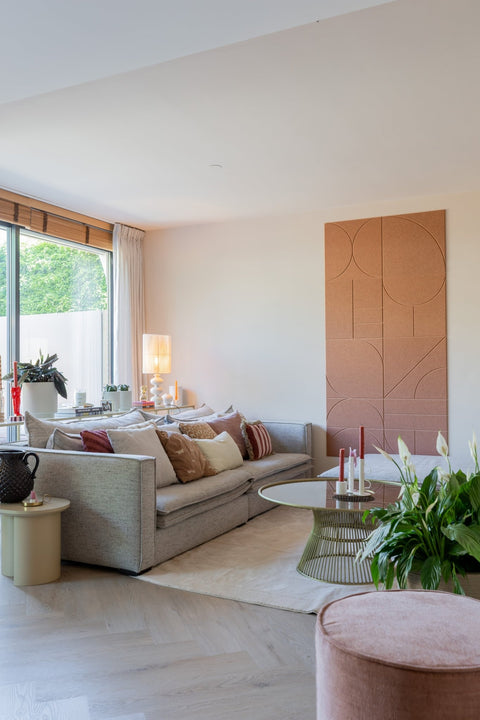
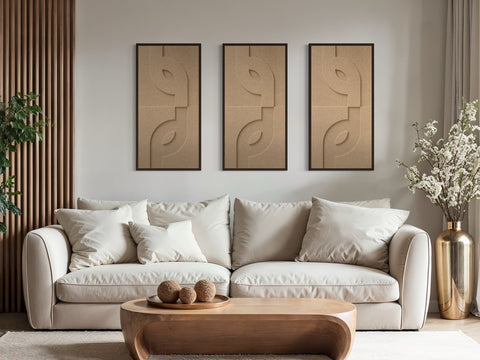
Whereas traditional ceiling solutions are primarily functional, modern acoustic panels offer scope for design.
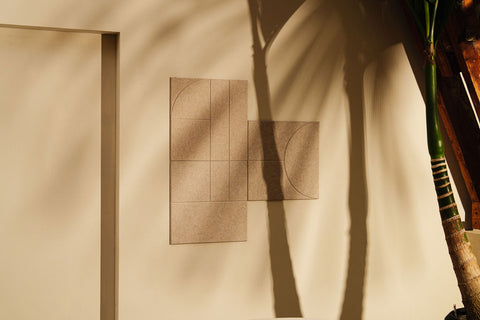
• Sleek rectangles, squares, or organic shapes
• Neutral shades such as sand and beige, but also warm accent colors such as cognac
• Combinations of multiple panels as a graphic ceiling image
This means that ceiling acoustics are not concealed, but rather used as an architectural element.
For which rooms are ceiling panels suitable?
Acoustic ceiling panels and islands are widely used in:
• Living rooms and open kitchens – less echo during conversations and TV sound
• Offices and meeting rooms – improved concentration and intelligibility
• Hospitality industry – more pleasant atmosphere, guests stay longer
• Showrooms and stores – quieter soundscape without disturbing the interior
Self-adhesive panels offer an immediate solution, particularly in existing spaces where renovation is not an option.

Assembly and practical considerations
• Start by identifying problem areas (above the table, seating area, workstations)
• Combine ceiling panels with wall panels for a balanced result
• Take lighting and installations into account during installation
• Choose materials with a suitable fire rating (All PET felt from Maeven Art has fire certification)
Thanks to their low weight, many panels are easy to install without requiring major structural modifications.
Maintenance and service life
• Acoustic ceiling panels last 15–25 years under normal use.
• Maintenance is minimal: vacuuming or light dusting
• Damaged panels are easy to replace without demolition work

Which ceiling acoustics suit your situation?
The right solution depends on:
• the degree of reverberation
• the desired appearance
• long-term flexibility
In many cases, modular acoustic ceiling panels and islands prove to be the most efficient combination of comfort, design, and investment.
Are you unsure how many panels you need or which shape best suits your space? Then it is wise to start with a practical estimate or trial setup, so you can immediately experience the effect.
Key points at a glance
• The ceiling plays a crucial role in the acoustics of a room.
• Complete renovation is not always necessary to reduce reverberation.
• Acoustic ceiling panels offer flexibility, design, and strong absorption
• Targeted placement is often more effective than complete coverage.
• Good ceiling solutions improve comfort, productivity, and atmosphere