Ceilings and Acoustics: Effective Panels and Design Solutions for Reduced Echo
Imagine this: you’re sitting in a crowded restaurant and you have to raise your voice to hear your dining companion. Or you work in a modern open-plan office where every conversation echoes off the ceiling. These are common signs of poor acoustic control.
Fortunately, there are now flexible and aesthetically pleasing solutions for reducing reverberation and echoes without the need for major renovations. In this blog, you’ll discover how you can improve acoustics through the ceiling and why modular acoustic ceiling panels and islands are the most practical choice for many spaces.
What is ceiling acoustics, and why is it so important?
Het plafond is in de meeste ruimtes het grootste reflecterende oppervlak. Harde plafonds zorgen ervoor dat geluidsgolven blijven rondkaatsen, wat leidt tot een lange nagalmtijd en verminderde spraakverstaanbaarheid.
An acoustic solution installed on the ceiling absorbs these sound waves, making the room feel quieter and making it easier to follow conversations.
Poor ceiling acoustics often lead to:
• Increased fatigue and difficulty concentrating, especially in work and learning environments
• Slechte verstaanbaarheid in woonkamers, keukens en horeca
• A restless atmosphere in spaces with concrete, glass, and minimal furnishings
In modern interiors with smooth floors, high ceilings, and few soft materials, ceiling acoustics are often the most effective first step.
Types of acoustic ceiling solutions
There are several ways to improve ceiling acoustics. The right choice depends on your budget, aesthetics, flexibility, and whether you plan to renovate.
Seamless acoustic ceiling
Seamless ceilings consist of a fixed structure made of mineral boards and a sprayed finish. They provide a sleek, monolithic finish, but require a permanent installation and a higher initial investment. This solution is primarily used in new construction or large-scale renovation projects.
Acoustic ceiling panels and ceiling islands
Acoustic ceiling panels and islands offer a flexible alternative. They are installed separately or suspended beneath the existing ceiling and immediately reduce reverberation. Thanks to materials such as PET felt, they combine high sound absorption with a modern, design-oriented look.
This solution is ideal when:
• you don't want to renovate
• flexibility is important
• The design may be a visible part of the interior
Acoustic suspended ceiling
A stretch ceiling is installed directly beneath the existing ceiling, with acoustic material in the cavity. This is not a quick fix, and it remains a permanent installation that offers less flexibility for future modifications.
• Are you looking for maximum flexibility and a stylish design? → Ceiling panels or islands
• Do you want to completely replace the ceiling? → seamless or stretch ceiling

Acoustic ceiling panels: how they work and their applications
Zelfklevende akoestische plafondpanelen absorberen geluid via hun poreuze structuur. Vooral panelen van gerecycled PET-vilt presteren sterk in het spraakgebied (500–2000 Hz), precies waar galm als storend wordt ervaren.
Types of assembly
• Mounted directly to the ceiling
• Suspended ceiling islands above tables or work areas
• Combinations of multiple panels for larger spaces
Because the panels are modular, you can move, expand, or reconfigure them later.
Sound absorption coefficient and acoustic performance
The sound absorption coefficient (αw) indicates how much sound is absorbed.
• Hoogwaardige plafondpanelen behalen αw-waarden tot circa 0,85–0,95, afhankelijk van dikte en montage
• Free-hanging islands absorb sound from multiple sides, making them particularly efficient
• By strategically placing multiple panels, reverberation time can be significantly reduced without covering the entire ceiling
In many residential and work environments, full ceiling coverage isn’t necessary: targeted installation often makes a noticeable difference.
Design, form, and color: acoustics as a visual element
While traditional ceiling solutions are primarily functional, modern acoustic panels offer opportunities for design.
• Clean rectangles, squares, or organic shapes
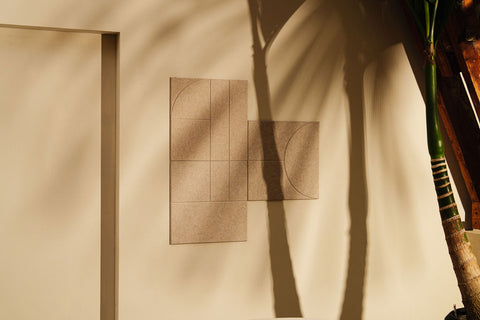
• Neutral tones such as sand and beige, as well as warm accent colors such as cognac
• Combinations of multiple panels to create a graphic ceiling design
As a result, ceiling acoustics are not concealed but are instead used as an architectural element.
For which rooms are ceiling panels suitable?
Acoustic ceiling panels and islands are commonly used in:
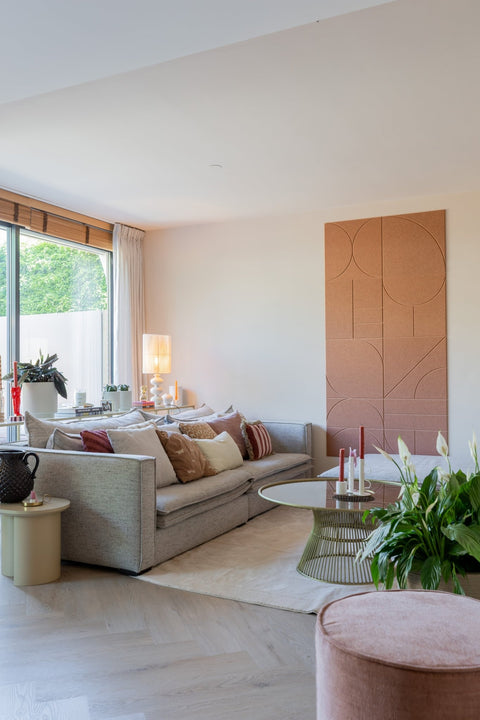
• Living rooms and open-concept kitchens – less echo during conversations and when watching TV
• Offices and meeting rooms – improved concentration and clarity
• Hospitality industry – a more pleasant atmosphere, guests stay longer
• Showrooms and stores – a quieter acoustic environment without disrupting the interior
Self-adhesive panels offer an immediate solution, especially in existing spaces where remodeling isn't an option.

Installation and practical considerations
• Start by identifying problem areas (above the table, seating area, workstations)
• Consider combining ceiling panels with wall panels for a balanced look
• Take lighting and electrical installations into account during installation
• Choose materials with an appropriate fire rating (All PET felt from Maeven Art is fire-certified)
Thanks to their light weight, many panels are easy to install without requiring major structural modifications.
Maintenance and service life
• Acoustic ceiling panels last 15–25 years under normal use
• Maintenance is minimal: vacuuming or light dusting
• Damaged panels can be easily replaced without any demolition work

Which ceiling acoustic solution is right for your situation?
The right solution depends on:
• the amount of reverberation
• the desired look
• long-term flexibility
In many cases, modular acoustic ceiling panels and islands prove to be the most effective combination of comfort, design, and value for money.
Not sure how many panels you need or which shape works best for your space? In that case, it’s a good idea to start with a rough estimate or a test setup so you can see the effect for yourself right away.
Key points at a glance
• The ceiling plays a crucial role in a room's acoustics
• A complete renovation isn't always necessary to reduce reverberation
• Acoustic ceiling panels offer flexibility, style, and high sound absorption
• Targeted placement is often more effective than full coverage
• Effective ceiling solutions enhance comfort, productivity, and ambiance