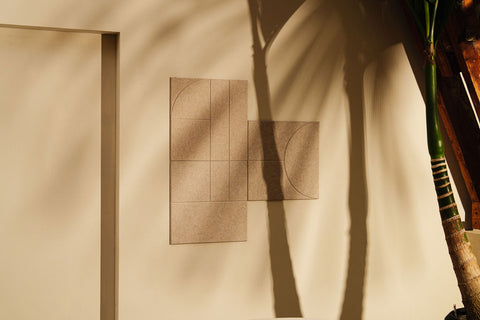
Is felt insulating? The facts about sound absorption, echo reduction, and insulation in the home
Felt has become extremely popular in modern interiors in recent years. You see it in wall panels, tiles, acoustic art pieces, and even in furniture. However, a frequently asked question is: “Does felt provide insulation?”
The answer is nuanced—and this nuance is crucial to expectations and satisfaction.
Many people think that felt blocks sound, but that’s not true. Felt is not soundproofing.
Wat het wél doet, is minstens zo waardevol: vilt absorbeert geluid binnen de kamer, waardoor echo, galm en harde nagalm verdwijnen.
In this comprehensive guide, we explain in detail how it works, the difference between insulation and sound absorption, which types of felt perform best, and how to use felt effectively to create a calmer, quieter, and more comfortable home.
1. Is felt insulating? The difference between sound insulation and sound absorption
The biggest source of confusion regarding felt is the term "insulation." This is because there are two completely different types of insulation:
1. Soundproofing
This means blocking sound between two rooms. This requires heavy materials such as:
• double layers of drywall with a cavity filled with rock wool or denim wool
• rock wool
• Decoupled walls
• rubber mats
Felt does not belong in this category.
Felt does not block out disruptive noise from neighbors, traffic, or noise between rooms.
2. Sound absorption
This means reducing noise within the room itself by eliminating echoes and reverberation. And this is exactly where felt excels.
The fiber structure of PET felt absorbs sound waves. As a result:
• Hard reflections, known as echoes or reverberations, are eliminated
• Sound no longer lingers
• speech becomes clearer
• makes a room feel much calmer
In short:
❌ Felt does not block sound.
✔ Felt absorbs sound and reduces echoes.
2. How effective is felt at dampening noise in the home—and why?
Acoustic felt works because sound waves that normally bounce off hard surfaces (walls, windows, ceilings) are now absorbed. As soon as the sound waves penetrate the felt, they collide with the fibers and lose energy. This results in audible quiet.
The effects you'll notice right away:
• less reverberation in the room
• a warmer and softer sound
• clearer conversations
• Lower TV and music volume
• a more comfortable sense of “silence”
Why PET felt works best
Not every type of felt absorbs sound equally well.
The most effective type is PET felt, because:
• it has a high density
• it retains its shape
• the sound penetrates deep into the material
• it is consistent over large areas
• the fibers are ideal for sound absorption
Thinner felt, such as wool felt (2–3 mm), is hardly effective.
The acoustics really start to improve at 9–12 mm; 9 mm is sufficient for residential use, while 12 mm pet-felt is recommended for large offices with open-plan layouts.
3. PET felt vs. wool felt — which material absorbs better?
Many people think that all types of felt are similar, but that’s not the case. Wool felt and PET felt have completely different properties.
Sheepskin: beautiful, but less effective
Sheepskin has a natural look, but:
• is less dense
• is less dimensionally stable
• is less suitable for large panels
• Does dampen sound, but less effectively
• is often more expensive
It's mainly decorative.
PET felt: the modern standard
PET-vilt is gemaakt van gerecyclede PET-flessen en is door de akoestische industrie omarmd omdat het:
• has a high density
• absorbs sound very well
• is colorfast and retains its shape
• suitable for panels, tiles, and artwork
• has excellent fire resistance (B-s1,d0)
• resistant tomoisture and mold
That is why virtually all modern acoustic wall art and panels are made of PET felt.
Conclusion:
✓ For sound absorption: PET felt is by far the best choice
✓ For decoration: wool felt works fine, but isn't as effective
4. How thick does felt need to be to effectively remove echoes?
Thickness determines the acoustic performance.
The thicker the felt, the better it absorbs sound waves.
Effect by thickness
• 2–5 mm → virtually no acoustic effect
• 9–12 mm → noticeable noise reduction (perfect for homes)
• 18–24 mm → high sound absorption for offices or meeting rooms
• > 24 mm → studio quality, not necessary for home use
For most homes, 9 mm PET felt is ideal.
5. Where does felt work best—on a wall, ceiling, or door?
Felt is most effective in areas where sound typically echoes. So the harder and smoother the surface, the greater the benefit you’ll get from acoustic felt.
Best places for acoustic felt
1. Walls (most effective)
Much of the echo is caused by sound bouncing horizontally off the walls. Felt on the walls creates an immediately noticeable sense of calm.
2. Ceilings
Ceilings reflect sound very strongly. Accoustic wall tiles felt panels on the ceiling are very effective at reducing reverberation.
3. Doors
A felt panel on a door reduces echoes within the room itself and makes the door open and close more quietly. It does not block sound from reaching other rooms.
4. Corners and large open areas
Felt panels placed behind TVs, in entryways, or in open living spaces immediately improve the acoustics.
Placing felt under the tables, as was done in the past, is pointless, because sound waves barely reach that area and therefore cannot be absorbed.
6. Is felt fire-resistant and suitable for homes and offices?
Modern PET felt meets high fire safety standards, including B-s1,d0, which means:
• fire-retardant
• Minimal smoke production
• no dripping
That is why it is suitable for:
• homes
• offices
• schools
• studios
In addition, PET felt is:
• odorless
• retains its shape
• sustainable
• colorfast
• Made from 40–60% recycled material and recyclable again
• mold-resistant
Conclusion
❌ Felt does not provide sound insulation between rooms
✔ Felt absorbs sound within the room itself
✔ It effectively reduces echo, reverberation, and reverberation
✔ PET felt is the best choice for modern acoustics
✔ Optimal performance starting at 9 mm thickness
Are you looking for peace, quiet, and a warmer acoustic experience in your home?
In that case, acoustic felt panels or acoustic wall decor are among the most effective and stylish solutions. Visit the website for more information and inspiration.